RBC Meeting Scheduler
Designing a scalable, accessible meeting scheduling app for RBC Wealth

My Role
UI & UX Design
Industry
Finance
Date
2020
Introduction
RBC Wealth previously relied on a largely manual scheduling process that created friction for both advisors and clients. Booking a meeting often required multiple touchpoints across email, phone calls, and calendar coordination.
As the sole UI/UX Designer on the initiative, I partnered closely with product managers and developers to design a responsive scheduling experience integrated into RBC’s Client View ecosystem. Initial high-fidelity designs were delivered within the first three months of the project, followed by ongoing design support and evolution from 2020–2026.
My work included discovery, user research, user flows, wireframing, interface design, prototyping, usability testing, analytics review, and developer handoff.
Problem
Investment advisors and clients relied on a fragmented and manual appointment scheduling process that created unnecessary administrative effort, delayed bookings, and reduced flexibility in how meetings were coordinated.
Advisors spent time managing availability manually while clients lacked an easy way to discover open times, select meeting formats, or manage appointments independently.
This resulted in:
High coordination effort through phone and email
Scheduling delays and unnecessary back-and-forth
Limited advisor control over booking preferences
Friction in the client experience
Increased operational overhead
Defining the Problem
How might we empower investment advisors and their clients to schedule and manage meetings more efficiently by reducing manual coordination and creating a flexible, self-serve booking experience?
Goals
The objective of the project was not simply to digitize scheduling, but to rethink how advisor-client meetings were coordinated.
The experience needed to reduce administrative effort, provide clients with greater flexibility, and give advisors more ownership over how and when they accepted appointments. At the same time, the solution needed to support multiple meeting formats, integrate into existing RBC systems, and scale over time.
Impact
The resulting experience helped move appointment scheduling from a manual process toward a more efficient self-serve model, reducing booking turnaround time by 40% and improving operational efficiency for both advisors and clients.

Users
This product served two connected user groups with different goals.

The Investment Advisor
Investment advisors needed a way to manage scheduling without spending time coordinating calendars or manually confirming appointments. They wanted greater control over availability, meeting preferences, and appointment management.

The Client
Clients needed a simple and transparent experience that allowed them to independently discover available times, choose how they wanted to meet, and manage appointments with confidence.
Constraints and Context
The scheduler existed within a larger RBC ecosystem and had to work within existing business and technical realities.
The experience needed to integrate with Client View while aligning with established platform patterns and compliance requirements. Technical dependencies, timeline expectations, and scalability considerations also influenced design decisions.
Rather than treating these constraints as limitations, they became useful boundaries that helped shape a focused solution.
Current Experience
Before the redesign, scheduling was largely dependent on human coordination.
Clients would reach out through email or phone, advisors would manually compare availability, and appointment details would be confirmed through multiple touchpoints. Any change to availability often restarted the process.
What should have been a simple action became repetitive operational work.
Mapping the existing journey revealed that reducing communication overhead represented one of the largest opportunities for improvement.
Research & Key Insights
To understand both business and user needs, I conducted discovery activities that included interviews, stakeholder sessions, analytics review, workflow analysis, and usability feedback.
Several themes emerged.
Scheduling itself was not the core value being delivered. Advisors wanted to spend time advising clients, not managing logistics.
Users also valued flexibility. Different meeting formats served different situations, and users expected those choices to feel integrated into a single experience.
Another recurring insight was that visibility builds confidence. Giving clients access to real availability reduced uncertainty and decreased unnecessary communication.
These findings became guiding principles throughout the design process.
User Flows
The experience was designed around two connected journeys.
Advisors defined availability, configured meeting preferences, and managed incoming appointments.
Clients moved through a guided booking flow where they selected a meeting type, viewed availability, confirmed details, and managed appointments afterward.
The flows were intentionally simplified to minimize decisions and reduce friction.


Solution Overview
The final experience introduced a centralized scheduling platform that connected advisor availability with client booking needs.
Instead of relying on back-and-forth communication, clients could independently schedule meetings while advisors maintained control over when and how appointments were offered.
The solution combined appointment discovery, meeting selection, confirmation, and management into a single cohesive workflow.
Final Designs
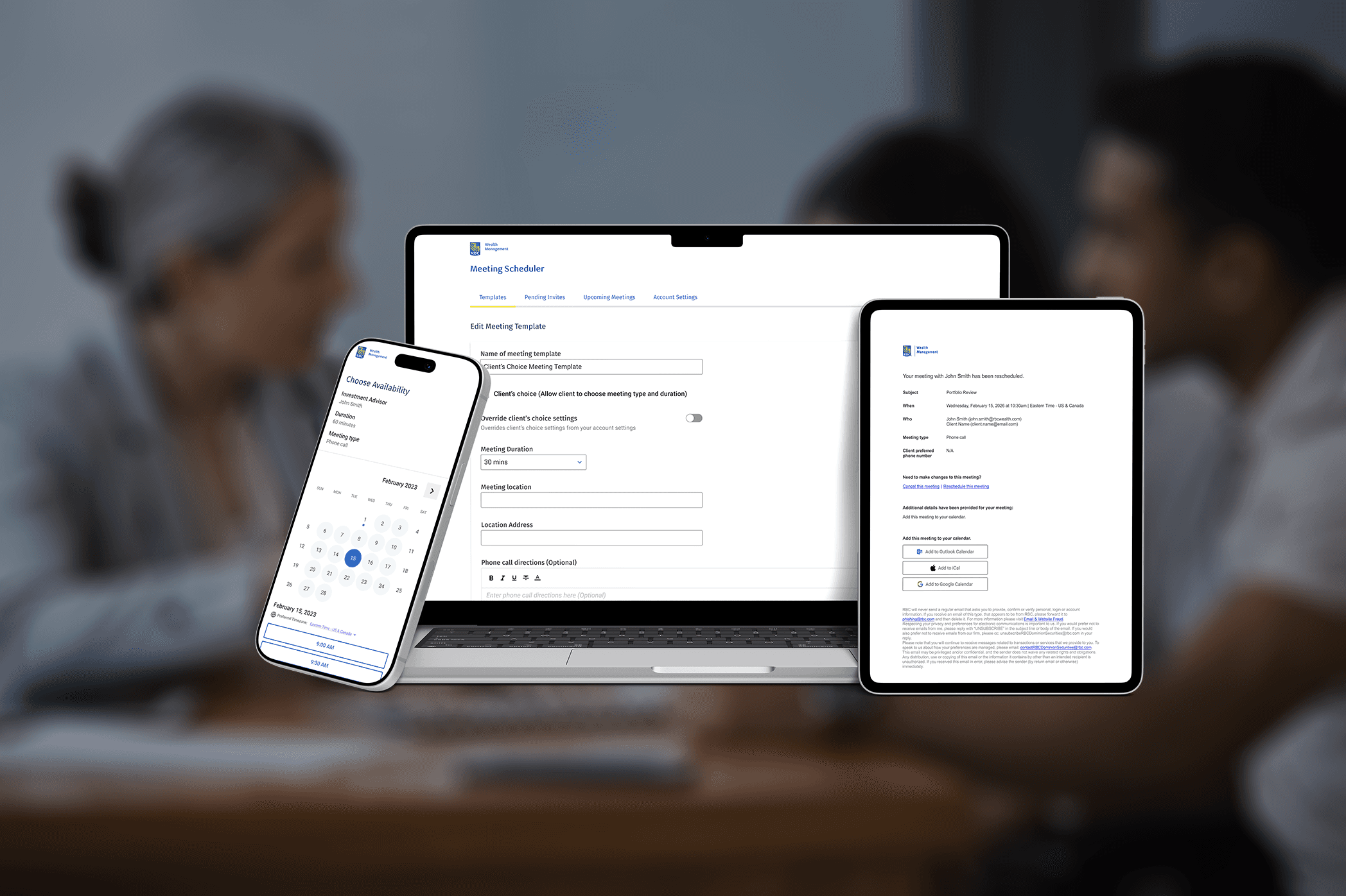
Meeting Invite Creation & Templates
One of the core experiences introduced in the platform was giving advisors more control over how meetings are initiated.
Instead of relying on manual outreach through email and calendar coordination, advisors could select a client directly from their existing client list and generate a personalized meeting invitation. Invitations could be created from scratch or generated using reusable meeting templates to reduce repetitive administrative work.
Templates allowed advisors to preconfigure important scheduling details such as available booking windows, meeting formats (in-person, phone, or virtual), and meeting-specific information. By creating reusable configurations, advisors could quickly send consistent and tailored invitations without repeating the same setup process each time.
This feature shifted meeting coordination from a manual communication exercise into a structured and repeatable workflow.

Advisor Account Settings & Availability Management
While advisors could customize availability at the meeting level, the platform
also introduced a more robust account settings experience that gave advisors long-term control over how they manage scheduling.
Advisors could define recurring availability preferences across different meeting formats and create scheduling rules that reflected how they actually worked.
Settings allowed advisors to:
Configure availability by day of the week
Set unique availability rules by meeting type
Define unavailable dates and holidays
Specify locations for in-person meetings
Control scheduling preferences across future invitations
By separating persistent scheduling preferences from one-off meeting configuration, the experience reduced setup effort while giving advisors confidence that their availability remained accurate over time.

Client Meeting Scheduling
On the client side, the experience focused on creating a simple and guided booking journey.
After receiving an email invitation, clients could follow a secure link to access the advisor’s customized scheduling page. Rather than negotiating availability through multiple touchpoints, clients were presented only with available dates and times that aligned with advisor-defined rules.
Once a client selected a preferred time, they reviewed and confirmed meeting details before receiving a confirmation email.
The experience also extended beyond initial booking. Clients could revisit their appointment and request updates or reschedule when necessary, creating a more flexible and self-serve scheduling process.
The result was an experience that reduced scheduling friction while maintaining advisor control over availability.

Validation & Iteration
The product continued to evolve through usability testing, stakeholder feedback, analytics review, and collaboration with development teams.
Prototype testing helped identify friction points and refine booking interactions, while ongoing feedback loops ensured the experience continued to meet business and user needs.
Supporting the product beyond launch reinforced the importance of designing systems that can adapt over time.